Benefits of Mental Maths Games for KS1 and KS2 Children
Kids love playing games on their phones and computers. Gaming is not an issue, but it must be a learning source for kids aged 6-11. Both parents and teachers are finding a way to make games productive for their kids. To enhance the learning capacity of the kids, one of the finest ways is to play mental maths games online. As per UK experts, mathematics is one of the main pillars of kids’ learning journey for both KS1 and KS2, as it strengthens kids’ mental maths and quick learning abilities.
The good news is that you do not need expensive software or a fancy classroom setup. Free maths games like hit the button are already being used in thousands of UK primary schools every single day. This coolest maths game helps children learn core maths topics like the times tables, number bonds, and division facts, etc, that help them build computation strategies. Let’s deep dive to know the benefits of playing these interactive maths games online.
What is a Mental Maths Game?
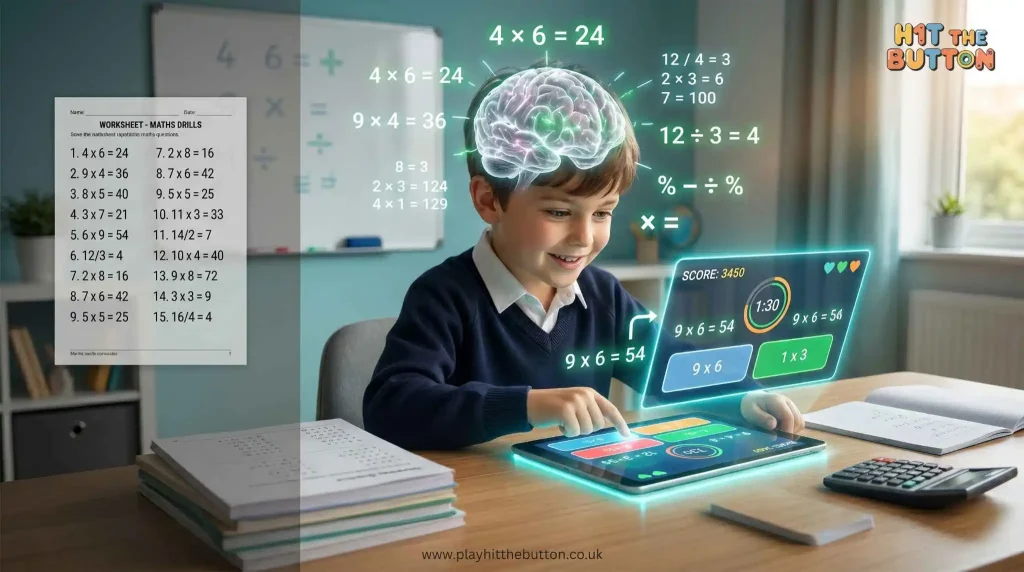
A maths game is not just a numbers activity. Actually, there is a clear difference between a maths game and a maths exercise. Now, you must understand this difference. In an exercise, you see a problem, select your choice, and wait for an answer. In contrast, a game gives you a challenge, a set of rules, and a reason to keep playing it if you get engaged.
A good maths game has 4 qualities;
That last point is the most important one. Always remember, not every game is interactive, engaging, and productive. Snake and dice rolling games are also online games, but these are not maths games, as these games are based purely on luck rather than on mental maths tricks of kids. Luck teaches nothing. These are waiting games. In real maths games, the child thinks, makes a strategy, and recalls maths facts in their brain. Every correct answer and every fast recall move them forward in their maths journey.
Take hit the button maths game as an example. When kids click on the “play now” button, a question appears on the screen. Several answer options also appear on the screen. The child has only one job: to find the right answer and hit it before the timeout. That single moment of decision repeats multiple times in 60 seconds of a game session. This t builds genuine number fluency. It is not luck. It is thinking. Fast thinking. And fast thinking is exactly what maths games are designed to train.
12 Benefits of Mental Maths Games
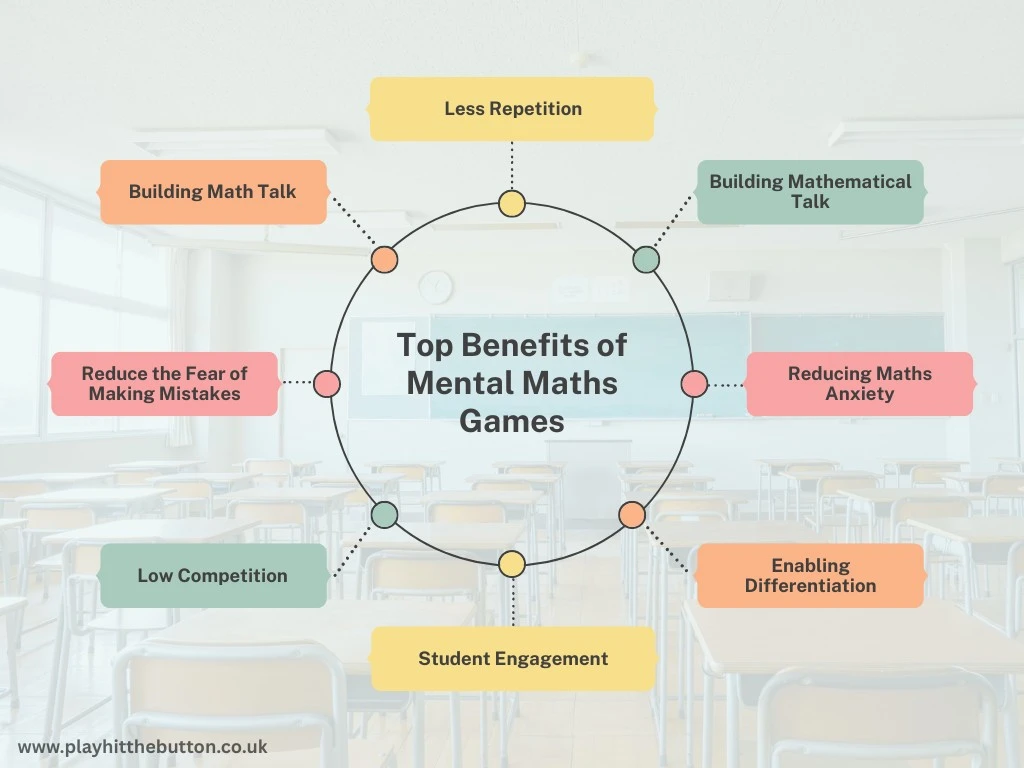
Mental maths games can change the thinking of a child. Here are 12 top benefits of playing a mental maths game online.
Less Repetition
Core maths subjects like number bonds and times tables require more practise sessions. When kids practise these subjects in a worksheet, they get bored. The best way to recall times tables through mental maths challenges online becomes more engaging and less repetitive.
Building Mathematical Talk
Mental maths games become more powerful when kids play together. When they see a question (4×6), one of them can say it is 24, not 28. That one sentence contains more mathematical thinking and productivity than 5 minutes of silent worksheet work. This mathematical language fits perfectly with the guidelines of the UK National Curriculum.
Reducing Maths Anxiety
One in five children in the UK experiences maths anxiety, and it’s a huge number. Maths anxiety can block brains to have new thoughts. One wrong answer during the maths games means try again, but that one wrong in the worksheet feels permanent. So, playing maths games is always a win-win for children to reduce the maths anxiety and boosts the self-confidence.
Enabling Differentiation
Every classroom has children of different levels. Some of them are intelligent, some are mediocre, and some noob. Keeping everyone appropriately challenged without making anyone feel down is one of the hardest things a teacher does.
Mental maths games make differentiation simple. Change the number range. Adjust the time. Switch the topic. The format stays familiar and comfortable while the difficulty shifts completely. Playing hit the button maths game feels so personal. In the same game, a year 2 child plays number bonds to 10, whereas a year 5 child plays division facts up to 12. They never feel left out due to their different mental levels.
Student Engagement
Solving maths questions in a worksheet is not a problem, but the problem is that kids do not like that manual format. Maths games grab more attention that worksheet does not. If kids get a game format on the worksheet to solve a maths problem, they will get engaged. That’s why maths games are designed in such a way to make it more interesting for kids.
Low Competition
Mental maths challenges involve both strategy and luck. The maths games are designed in such a way that even a high achiever in the maths subject can lose the game, as the game has all types of questions. That’s why students with the each mental level can play this game.
Reduce the Fear of Making Mistakes
In the whole class, when a student puts up their hands and gives the wrong answers, they feel huge embarrassment because other children are watching, and the teacher is watching too. For many children, the fear of making mistakes in gathering is more than enough to give up on learning or trying again. In a maths game, a wrong answer disappears in a second, and the next question appears. Children who fear giving the answer to any question in the classroom can freely answer during the game, as no one is watching. This willingness to give the answer to any maths questions actually improves the performance of kids.
Building Math Talk
Mathematical language is a skill in itself. When students play mental maths games together, they are involved in productive maths talks. They can share their findings on the maths facts. They can provide their own logic for solving a maths equation. They argue, explain, and justify. A child who plays mental maths games regularly with a partner develops stronger mathematical communication than one who learns only from the maths textbooks.
Build Emotional Skills
Games teach emotions. During the mental maths game, kids learn how to have patience, how to keep trying even after failure, and how to cooperate with the partner. These are the core skills that children need for the whole of their lives. Every time kids play mental maths games, they practise all of these skills naturally.
Strengthen Maths Skills
When a teacher introduces a new maths concept in the class, kids understand it for a while, but it becomes blurry when they go home. This is where a child needs a maths game to practise. Mental maths games help children to remember each maths concept they learn in the class by practising it more and more.
Student Independence
Once the students learn the maths concepts, they can easily play mental maths online without the help of their peers. When a teacher sees a child playing maths games independently, they can build a small group for a better learning environment.
Build Problem-Solving Skills
The main purpose of the mental maths games is to improve the strategic thinking of a child. They can’t build this skill while solving a maths problem in a worksheet because of its old traditional format. Kids who play maths games regularly become calmer under pressure, use their brains and creativity, and think smarter than a child who does not play maths games. These are skills that help in every subject beyond maths.
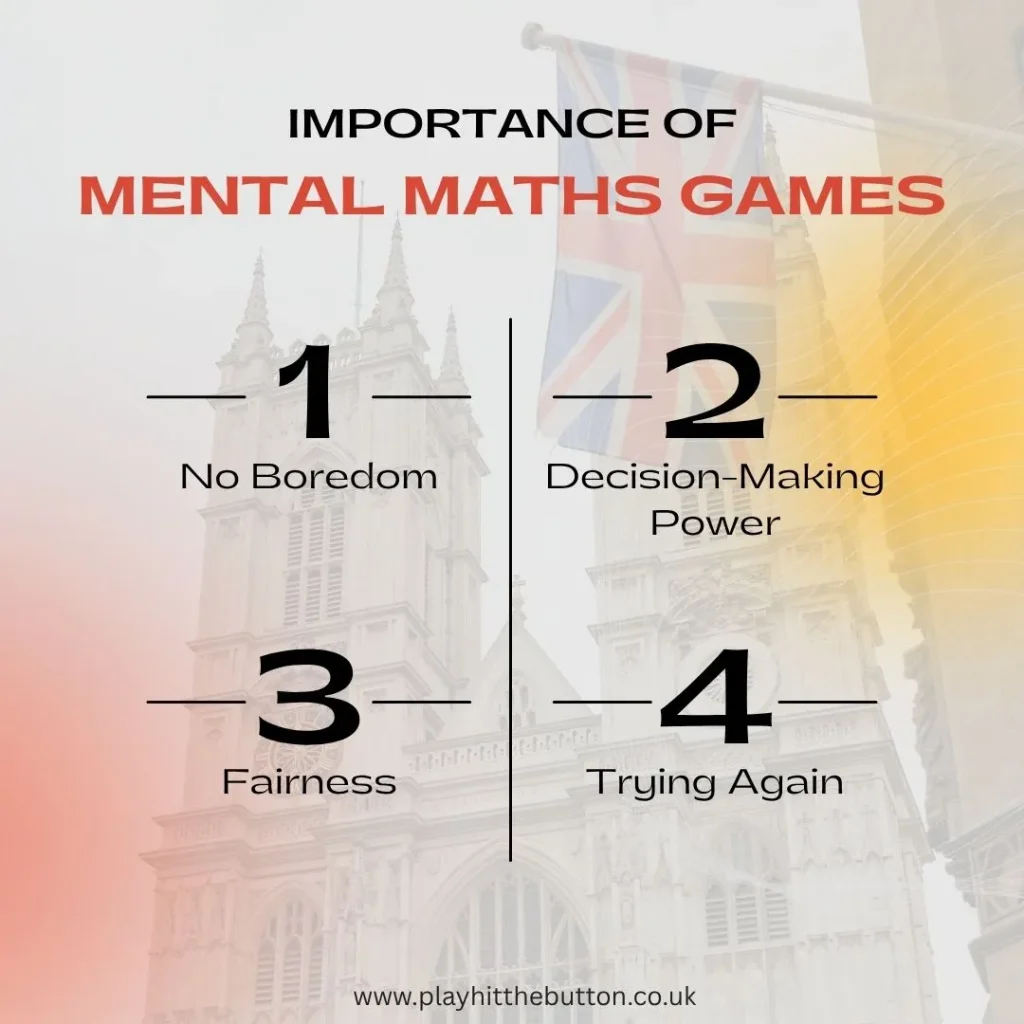
Importance of Mental Maths Games
6 to 11 years of age is crucial for children as they build their basic mathematical concepts during this age. They rely on these concepts for the rest of their lives. They learn times tables, number bonds, and fractions in their crucial age period. During this age, they need both confidence and accuracy to get better at maths in their whole learning journey.
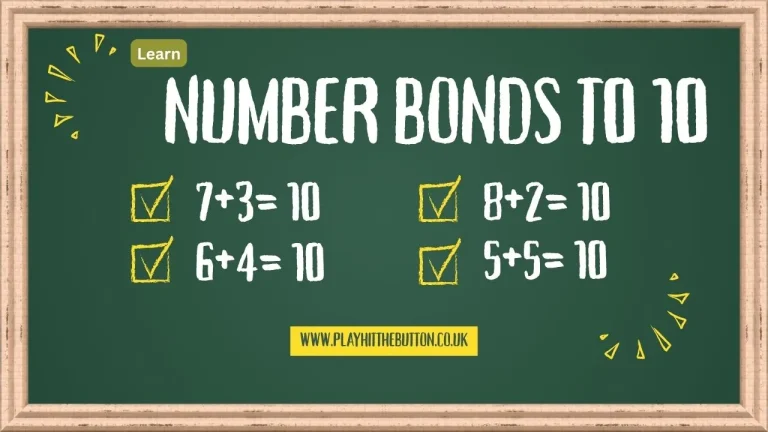
According to the research of the University of Chicago, children who play number bond games at home have a stronger grip on maths concepts when they start school. Understanding how number bonds build that early number sense is one of the biggest advantages games have over traditional worksheets.
Here is why maths games are so important for KS1 and KS2:
One important thing I want to clear here. Maths games can never replace good teaching. Kids always need a teacher who explains concepts clearly and builds understanding first. But once kids clear their concepts and have a complete understanding, games are one of the most effective tools to practise what they have learnt from the teacher.
How to Identify a Mental Maths Game?
It is a genuine problem to identify which game is actually a maths game. Is every number game a maths game? Absolutely not. Not every game with numbers in it is a maths game. Watching a maths video where a guy solves a maths problem is also not a maths game. A real maths game involves kids and makes them think, decide, and act. That is the difference.
Below are the 3 types of activities that are included in a maths game;
One of the main differences between a maths game and a worksheet is instant feedback. In a worksheet, kids solve 20 questions and wait for the answers from the checkers. In a maths game, kids solve one question and get the answer to it without waiting. They instantly know if their answer is right or wrong. That instant feedback is what makes digital maths games so powerful.
UK National Curriculum Requirements
Every maths game should be aligned with the UK National Curriculum to make these games more useful for kids in both Key Stage 1 (KS1) and Key Stage 2 (KS2). Here is the breakdown of how maths revision games are supposed to be:
KS1 Expectations (Ages 6–7)
At KS1, children are learning the basics. Counting, reading and writing numbers, addition and subtraction within 20, early multiplication ideas, and simple fractions like halves and quarters.
Maths games at this stage need to keep 3 things in mind:
A game like hit the button maths works well at KS1 when it comes to learning the basics of times tables and number bonds, where the questions are simple enough for a 6 or 7-year-old to answer confidently. For example, practising the 4 times tables is a great starting point for Year 3 children.
KS2 Expectations (Ages 7–11)
Maths becomes more demanding at KS2. In this key stage, children are expected to know all times tables up to 12 x 12 by the end of Year 4. They move into fractions, decimals, percentages, geometry, and multi-step problem solving.
At this stage, where maths becomes more interesting, it should also be more challenging at the same time.
Here are the 3 things to know at KS2:
4 Risks of Mental Maths Games
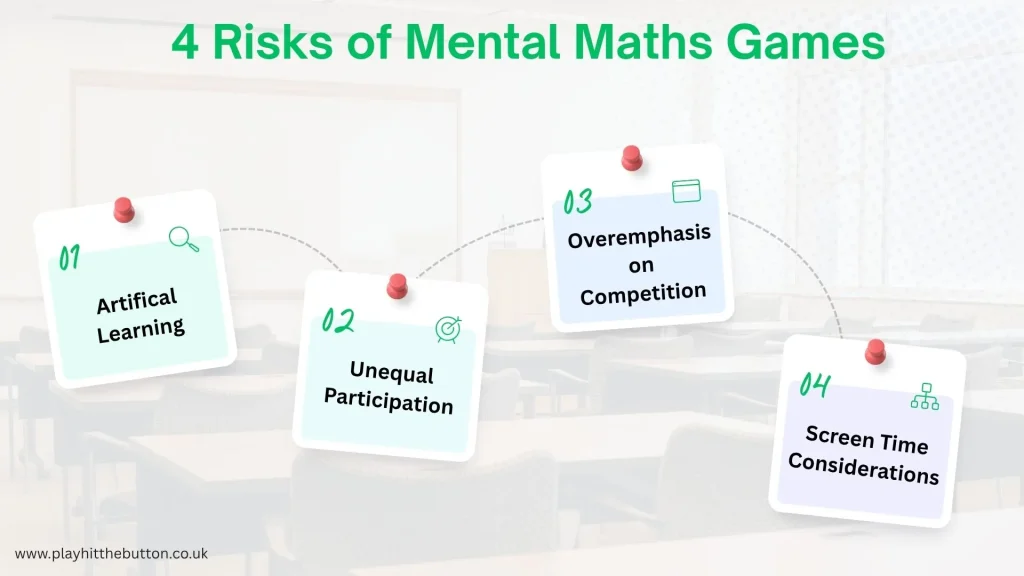
Mental maths games are powerful, but like many digital tools, they also have some risks. Here are the 4 risks worth knowing.
Artifical Learning
Speed is great. But speed without understanding the real problem is just guessing fast. When children start playing mental maths games, they can think that they have to just hit the answer, even without thinking about the real maths problem. They can just try to win that single game session even without focusing on their accuracy.
Unequal Participation
When you put six children in a group to play a maths game, two will dominate, two will participate occasionally, and two will just watch others playing. This is one of the most common problems in the classroom. Teachers must think and strategically plan the group inclusion.
Overemphasis on Competition
Not every child has the same confidence level. No doubt, playing mental maths games builds confidence, but playing such games may not be suitable for all the children equally. Teachers and parents must encourage children to beat their own previous score rather than beating other children.
Screen Time Considerations
Digital maths games are easier and more effective than traditional paper games. But every digital game can increase the screen time of children, which may cause the eye sight problems. Parents must ensure the balanced screen time among their children to make them feel healthier and more focused, even in the classroom.
Ideal Time to Use Mental Maths Games
Mental maths games become more productive when play on a right time. Here’s the best time to play such a brainstorming maths game.
In the Classroom
Actually, there are no separate mental maths games for the classroom. Teachers can get more benefits from maths games for kids when they plan a purpose with it. Here’s how to do it:
Before the game:
During the lesson:
After the game:
Always remember that a game without a learning purpose is just entertainment. A hard math game with a 2-minute brief becomes the powerful learning tool.
At the Home
Parents do not need to be maths teachers to help their children learn maths. Keep it simple and keep it positive.
5 practical tips for home use:
What maths games at home should sit alongside:
Final Words
Nothing better than mental maths games when it comes to kids’ maths journey for KS1 and KS2. At the same time, these games are engaging, productive, UK Curriculum aligned, and one of the most modern ways of learning maths. Maths games give kids both educational and social benefits. The best way to get the maximum from mental maths games is to just beat the own high score. According to the Education Endowment Foundation, immediate feedback is one of the best strategies for improving primary maths skills.
The debate is not whether the mental maths games are useful or not, but knowing when and how to use these digital mental maths challenges is the real achievement. Mental maths trains kids’ minds and makes them learn how to make strategic decisions, how to be patient, and most importantly, how to try again even after the wrong answers.