How to learn 4 Times Table with Practise Game
Learning the 4 times table is a major step in building mental maths, but it often causes stress for kids. Most of the time, kids get confused between the 2x table and the 4 times table (because of doubling 2). But if they use the 2x table wisely, they will get closer to answering any 4x table question.
You can easily fix this problem by teaching them 3 simple math tricks to find the right answers quickly. This guide provides clear explanations and exact steps to build their confidence. You can also play hit the button, a free maths game used in thousands of UK schools, to make 4x table practice fast and actually fun.
What is a 4 Times Table?
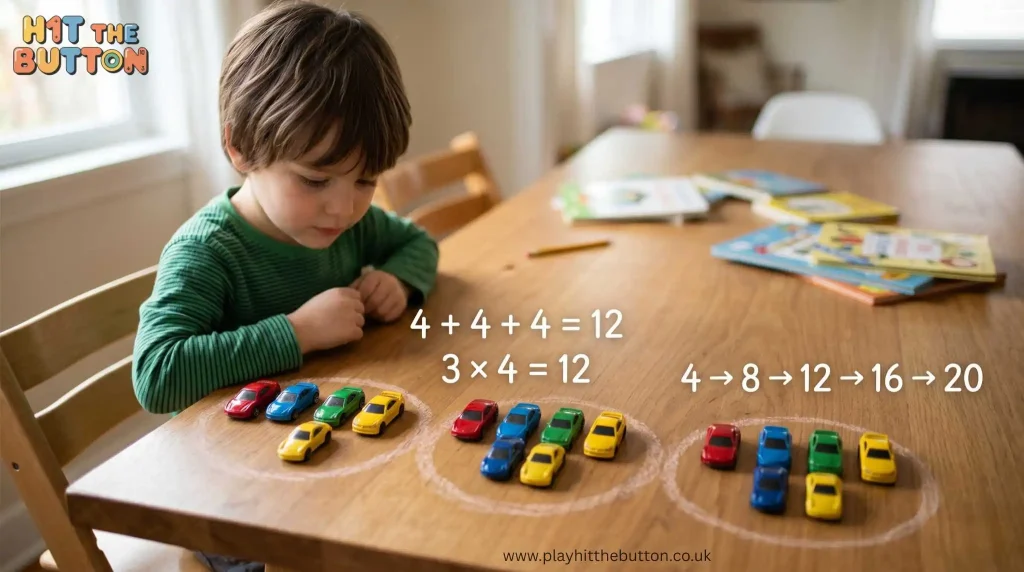
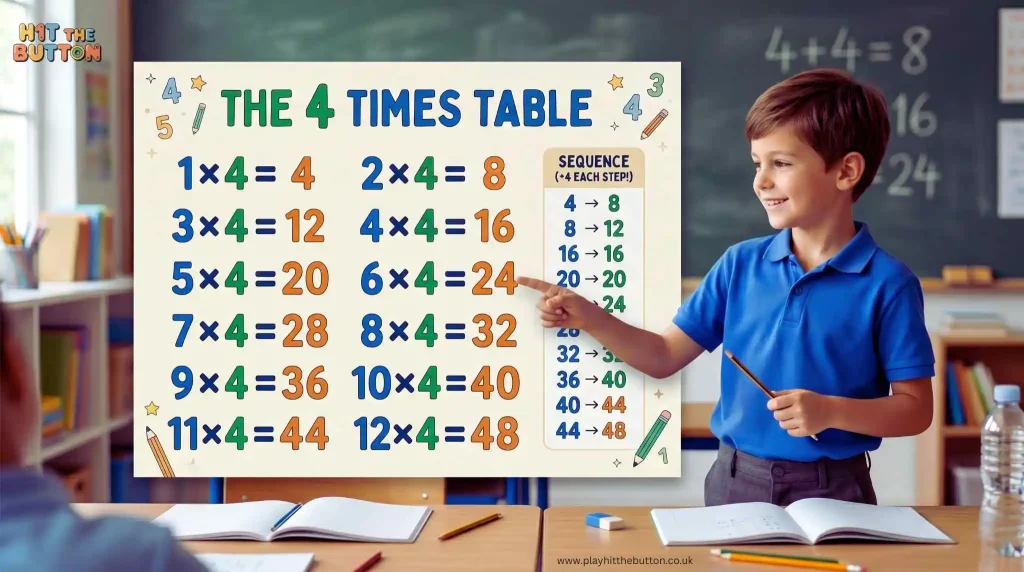
The 4 times table is a set of multiplication facts where 4 is added over and over again. It is simply counting in fours: 4, 8, 12, 16, 20 and so on.
For example, if you see 3 cars and each car has 4 wheels, you have 3 × 4 = 12 wheels in total. That is all multiplication is. Groups of the same number added together.
Here is the 4 times table chart.
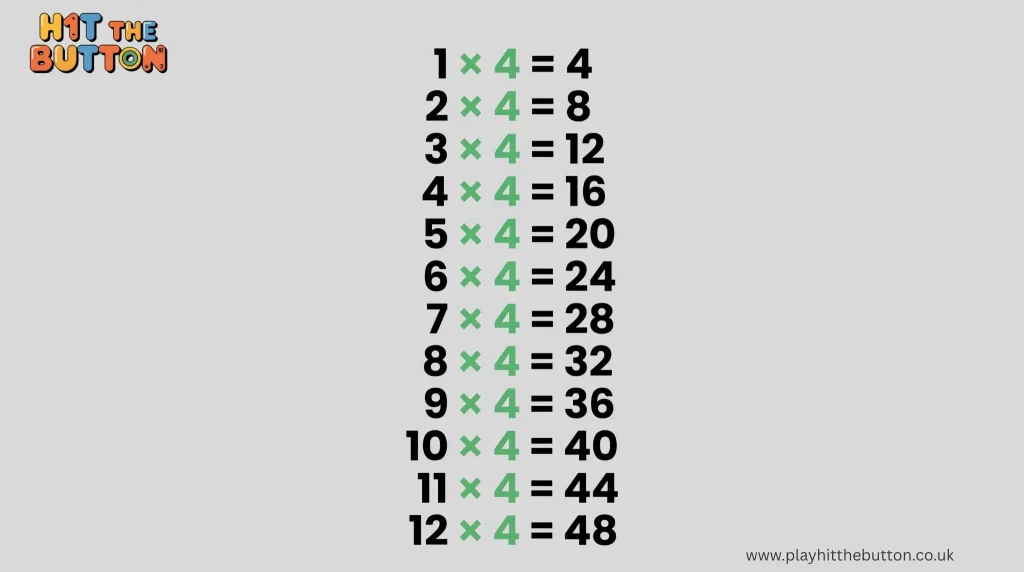
The four times table is a medium level of difficulty. It is easier than the 7, 8, and 9 times tables, but it is slightly harder than the 2, 5, and 10 times tables, as it does not have a simple zero or five at the end. If your child already knows the 2 times table, they are halfway there, as the 4x table is simply the 2 times table doubled.
Importance of 4 Times Tables

Knowing the four times table is not just about passing a test. Here is why it matters across 3 areas.
At School (KS1 and KS2)
Primary school students in the UK must master all the tables of multiplication up to 12 by 12 before finishing Year 4. Teachers usually start teaching the four times table during Year 2 or Year 3. This specific number set is very important because it unlocks 4 major math topics your child will face in the classroom:
The biggest reason to learn these numbers early is the official government exam called the Multiplication Tables Check. In this Year 4 test, children have exactly 6 seconds to answer each math question. They absolutely will not have time to count on their fingers, so building instant memory is the only way to pass.
Real Life Examples
The 4 times tables are one of the most practical in all the tables of multiplication. Children use it in real life more than they realise.
Here are 6 everyday examples:
- Car Wheels: 4 wheels × 5 cars = 20 wheels.
- Animal Legs: 4 legs × 6 cows = 24 legs.
- Seasons: 4 seasons × 3 years = 12 seasons.
- Packaging: Chocolate bars come in rows of 4, cans in packs of 4.
- Sports: A relay race has 4 runners, and a rugby team scores in multiples of 4 points.
- Money: Splitting £32 between 4 friends means each gets £8 (and yes, 32 times 4 works in reverse too).
When a child sees the 4x table in their daily life, it stops feeling like a school subject. It starts feeling useful. That shift in thinking is what turns reluctant learners into confident ones.
Brain Exercise
When a child counts numbers on the fingers, it consumes a lot of brain energy. If they have to spend more time solving a basic math fact, they will get stuck on their homework questions. This is why memorising the 4x times tables is so important for their mental growth.
3 Steps to Learn the 4 Times Table
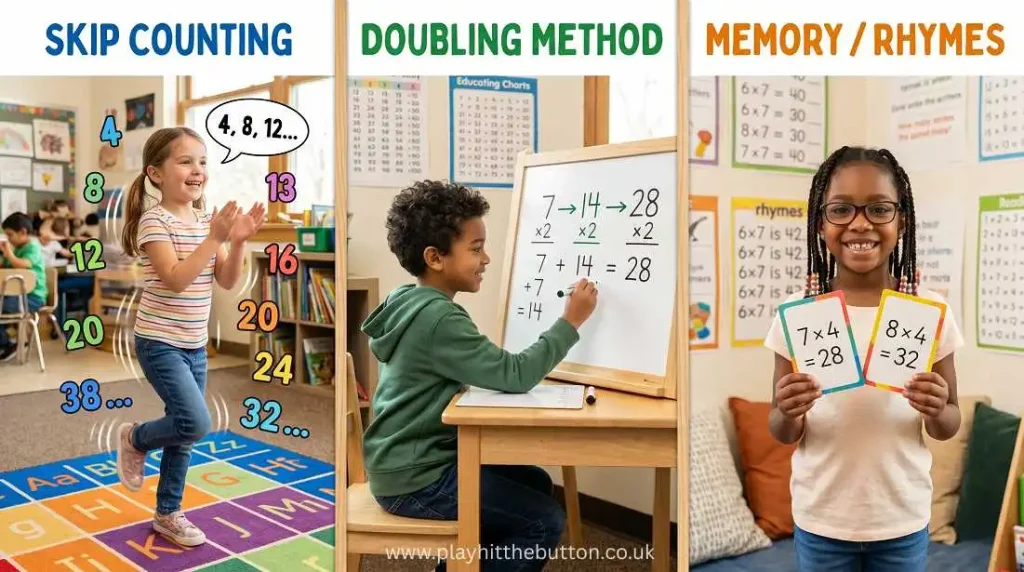
Teaching your child does not need to be a long process. While many parents wonder how to memorise times tables in general, I have created a simple 3 step guide to help your child master the fours quickly I have created a simple 3 step guide to help your child master the four times tables quickly. Let’s explore;
Counting in Fours
Before you force your child to memorise any math numbers, they must learn how to skip count. This simply means reading the numbers out loud like a fun song. Start by saying 4, then 8, then 12, then 16 and keep going all the way up to 48.
Such as: 4, 8, 12, 16, 20, 24, 28, 32, 36, 40, 44, 48
To make this stick in their brain, ask them to clap their hands every time they say a number. Just say 4 and clap, say 8 and clap, and so on. This physical movement helps the brain remember the 4x table pattern rapidly. Once they can count forwards easily, you should challenge them to count backwards to really test their memory (reverse counting).
Use the Doubling Method
Here is the best secret for the 4x table. To multiply by 4, you just need to double your number twice. Since most children already know their 2 times table, this amazing trick gives them a clue they can always go with.
Let us look at a simple example to show how this works. If you need to solve 7 times 4 (7×4=28), you just double the 7 to get 14. Then you double the 14 to get your final answer of 28 (14×2=28). This simple logic works for everything, and you can even solve huge numbers like 32 times 4 just by doubling twice to get 128.
Remember Rhymes
Every student gets stuck on a few specific multiplication facts. Research shows that learning the middle numbers is where kids usually freeze. Instead of repeating the entire 4 multiplication table, you should focus only on the exact numbers that cause trouble. You can use simple bullet points and silly rhymes to help them remember.
- 7 x 4 = 28: 7 times 4 is 28, so hurry up and close the gate!
- 8 x 4 = 32: 8 times 4 is 32. Now, tell me what my dog can chew!
- 9 x 4 = 36: Double the number 18.
Create three simple flashcards for these exact math questions. Keep testing your child every single day until they can shout the correct answer in under three seconds. Always practice the hardest numbers first before their young brain gets tired.
4 Top Secrets to Remember 4x Table
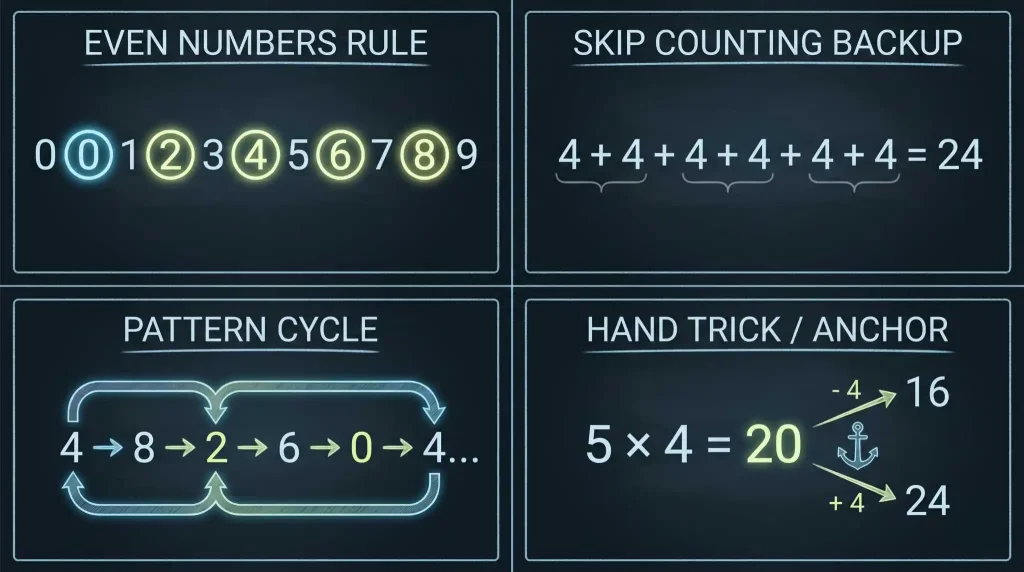
Here are some notable shortcuts to have a strong grip on 4x time tables;
Remember Even Numbers
Every single answer in the four times tables will always be an even number. This means your final result must end in a digit of 0, 2, 4, 6, or 8. If your child calculates an odd number like 15 or 27, they know they made a small mistake.
Skip Counting
Sometimes a child will completely forget a specific number during a school test. Skip counting acts as the perfect backup plan when their memory suddenly goes blank. If your child forgets how to multiply by 4 in a specific question, they do not need to panic. To solve 4×6, they can just add the number 4 exactly 6 times in a row. By adding 4 plus 4 plus 4 plus 4 plus 4 plus 4, they will safely reach 24. This simple trick helps them find the correct answer without relying on memory alone.
The Last Digit Pattern
Look closely at the answers in the 4 times table, and you will find a hidden code. The last digit of every answer always follows one exact sequence. The numbers always end in 4, then 8, then 2, then 6, then 0. After you reach 20, this exact 5-number pattern starts all over again.
Hand Trick
Children usually find the five times table very easy to learn using one hand. We can use the answer for 5 times 4 as a strong stepping stone to solve harder questions. If your child remembers that 5 times 4 is exactly 20, they can easily find the numbers right next to it.
To find out what 4 times 4 is, they just need to subtract four from 20 to get 16 (20-4=16). If they need to solve 6 times 4 they simply add four to 20 to reach 24 (20+4=24). This simple shortcut completely removes the need to start counting from the very beginning of the list.
10 Common Mistakes in Learning 4 Time Table
Even the smartest students make a few simple errors when learning the 4s times tables. Recognising these bad habits early will save your child from feeling frustrated during their math homework.
Here are 10 common mistakes kids make and the exact steps you can take to fix them at home. Don’t forget to take note of the last mistake!
Confusing between 3x and 4x Table
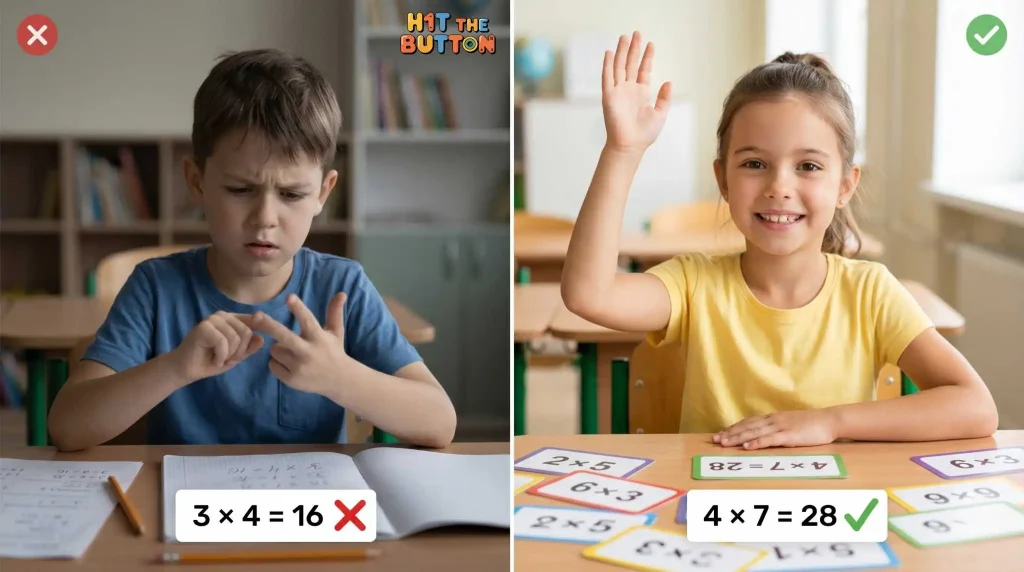
Many children mix up 3x and 4x times tables and think 3 times 4 is 16.
How to fix: Practice these two sets completely separately. Use different colored flashcards for each list so their brains do not mix them up.
Thinking Backwards is Different
Kids often believe that 4 times 7 is a completely new math problem than 7 times 4.
How to fix: Put small toys on the table. Show them that 4 groups of 7 make exactly 28, and 7 groups of 4 also make 28.
Stopping at the Number 10
Most parents stop testing their kids after reaching 10 times 4.
How to fix: Primary schools require kids to know all the multiplication tables up to 12. Always include 11 and 12 in your daily practice so they do not fail their final exams.
Panicking Under Pressure
When a school timer starts ticking, children try to count too fast and completely lose their place.
How to fix: Use short daily speed tests. Let them play online maths games for just 60 seconds every day to build their confidence under a ticking clock.
Counting on their Fingers
Using hands is a very slow habit that hurts their mental math speed.
How to fix: Gradually force them to rely on their memory. Pick just 3 mental maths tips and tricks to memorise each day and test them until you can answer without looking down.
Forgetting about Division
If kids do not learn division at the exact same time, they will struggle heavily in higher classes as division and multiplication are interconnected.
How to fix: Connect the two topics immediately. As soon as they learn that 4 times 6 is 24, ask them what 24 divided by 4 is.
Memorising in a Straight Line
Singing the numbers in perfect order means they only know the song and not the actual math.
How to fix: Real school tests always ask random questions. You must completely mix up their flashcards so they truly learn how to multiply by 4.
Ignoring the Double Method
Kids often try to count one by one instead of using the simple shortcuts they already know.
How to fix: Remind them they already know the two times tables. Tell them to just double their number twice to get the correct answer instantly.
Practising for Way Too Long
Studying for a whole hour on the weekend makes a young brain very tired and bored.
How to fix: Keep your math lessons short. A fun 10-minute session every single day is far better for building a strong memory.
Writing down Odd Numbers
Students often guess the answer and write down odd numbers like 17 or 25 on their paper.
How to fix: Remind them of the even number rule. Teach them that every single answer in the 4 table maths must end in a 0, 2, 4, 6 or 8.
3 Engaging Ways to Practise 4 Times Table
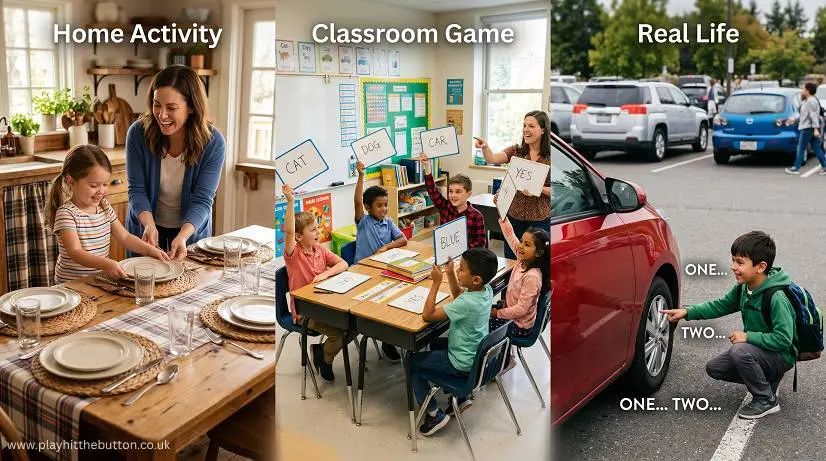
You can use simple daily activities to make learning the 4s times tables an exciting game for your child, both at home and inside the classroom.
At Home
Parents have the best opportunity to turn normal daily routines into a fun math lesson. When children play with real physical objects, they understand how to multiply by 4 much faster.
Here are 4 simple activities you can try in your house today;
In the Classroom
Teachers can easily turn a boring math lesson into an exciting group activity. When students play together they forget they are actually studying.
Here are 4 highly engaging classroom games to help students master their four times tables as a team.
Real Life Case Studies
When kids realise they can use these numbers outside the classroom, they feel extremely smart and capable.
Here are 4 everyday situations where they can naturally multiply by 4 without even realising it.
4 Times Table Practice Questions
Want to test your child if they have gripped on 4 times table? Here is the 4 times table practice game. Let’s test their skills.
6 Expert Tips for Parents and Teachers

Teaching multiplication does not require a special teaching degree.
Here are 6 expert strategies to help you guide your child without causing any tears or frustration.
Start with Physical Objects
Before asking a young student to memorise numbers on paper, you must let them touch real items. Grouping small toys or buttons into exact piles of four builds a real understanding in the brain. This physical step shows how the math works and stops them from just guessing random answers later.
The 5 Minute Daily Rule
A young brain actually stops learning when it gets too tired. Practising for just 5 minutes every single day is completely proven to work much better than studying for 30 minutes on a Sunday. Short daily tests force their memory to stay active and lock the numbers in permanently.
Focus Only on the Weak Spots
Do not make your child repeat the easy numbers they already know perfectly. Give them a quick test and find the exact 3 or 4 questions they think are tough. Spending all your daily energy practising those specific weak spots will save you massive amounts of time.
Use 3 Different Practice Methods
Doing the exact same math worksheet every single day will make your child incredibly bored. You should mix up their routine by using verbal quizzes, paper flashcards, and fast digital games like Press the button. Changing the activity completely keeps their mind fully awake and deeply engaged.
Teach Division at the Same Time
Multiplication and division are basically the exact same thing, just done in reverse. The moment your child learns that 4 times 8 makes 32, you must immediately ask them what 32 divided by 4 is (32/4=8). Connecting these two topics early makes their future math classes incredibly easy.
Reward the Learning Process
Your child will definitely make mistakes and give you the wrong answer sometimes. If they try hard to use the doubling trick but get the final number wrong, you should still praise their amazing effort. Cheering for their hard work builds massive confidence and stops them from ever wanting to quit.
4 Times Table Practice using Hit the Button Game
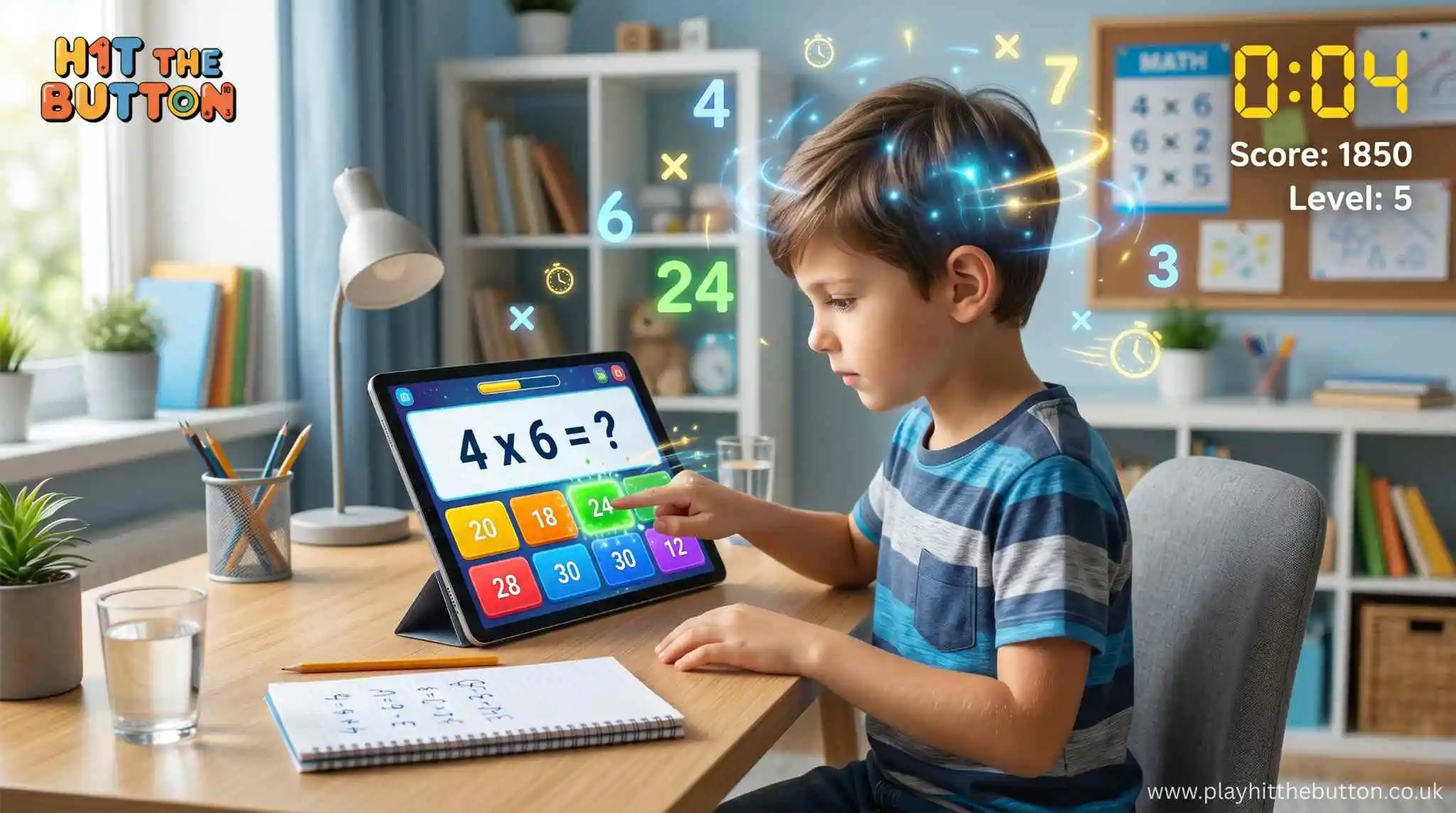
If your child finds the 4 times table easy on paper but gets stuck during a test, the problem is not knowledge. It is speed. And speed only comes from one thing: repeated practice under pressure. The best way to build incredible times table speed is by using the hit the button online game. This free online maths game is highly loved by primary school teachers across the UK because it completely transforms a boring homework session into an exciting digital playground for both KS1 and KS2 students.
It is simple to use. A question on the screen appears and your child just has to hit the answer before the clock runs out. No typing. No complicated setup. Just fast, focused mental maths practice. This specific time pressure forces their brain to completely abandon finger counting. Instead of working the problem out slowly, they learn to pull the 4 times table facts straight from their memory.
Here are 3 core reasons why hit the button maths game is a perfect practice activity for the 4 times table;
Hit the button maths game is absolutely essential for Year 3 and Year 4 students who are actively preparing for the UK Multiplication Tables Check (MTC). This test requires correct answers in just 6 seconds, and this activity teaches kids the time management perfectly.
You do not need to force them to play for too long, as this may make the game boring due to repetition. Just 5 to 10 minutes of daily consistent practice will create massive and measurable improvements in just two to three weeks. Your child will finally enjoy learning, and their math anxiety will completely disappear.
Start on questions 1 to 6 times 4 to build confidence first. Then push to the full 4 times table up to 100 as they improve.
Truth Behind Fast Mental Maths
When a child works very hard to multiply by 4, their working memory gets completely full. Scientists actually call this cognitive load. If a student uses all their brain power just to count their fingers, they will completely forget the rest of the school question.
They need to make their memory automatic so their brain can finally relax. Achieving instant memory changes absolutely everything for a young student.
Here are 3 scientific reasons why fast recall is very important;
This exact science is why fast digital tools work so perfectly. Playing a quick game targets the huge gap between finding an answer slowly and knowing it. It forces their young brain to build a permanent memory pathway. Once they master the 4th time, you can easily introduce new math topics and explore what are number bonds without any fear.
Final Words
Mastering the 4 times table is the ultimate secret to unlocking much harder math topics like fractions and long division. When your child stops relying on their fingers and starts using the simple doubling method, their daily homework will finally become totally stress-free. Remembering the tricky middle facts takes a little patience, but consistent daily practice is the absolute best way to build real mental speed.
Do not panic if your child makes a few mistakes at the very beginning because building a strong memory always takes time. You can easily read about how spaced repetition improves learning to understand exactly why short daily lessons work much better than long weekend study hours. Just encourage them to play hit the button for five short minutes every single day, and you will quickly watch them become a true math champion.