What are Number Bonds? Easy Guide for Parents and Teachers
As the name suggests, number bonds are simply two numbers that meet together to form a strong number bond. If you are still confused about what are number bonds, the answer is very simple. Number bonds show kids ‘part-part-whole’ relationship of different numbers. They help kids understand how 4 and 6 come together to make 10 in addition (4+6=10). Simple maths practice, online games, and activities like hit the button help children learn faster and feel confident with numbers.
What is a Number Bond?
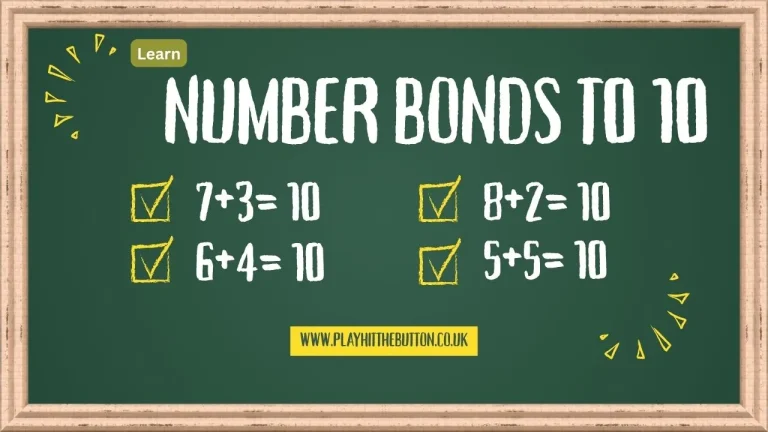
A number bond shows how a number can be split into smaller parts and joined again. In simple words, number bonds explain the relationship between the whole number and its counterparts. For example, if the whole number is 10, the parts can be 7 and 3, 6 and 4, or 5 and 5. Means addition of 7 and 3, 6, and 4, or 5 and 5 gives the same answer, that is, 10. Each pair makes the same total. There are 11 ways to split number bonds to 10 as given in the example below;
0 + 10 = 10
1 + 9 = 10
2 + 8 = 10
3 + 7 = 10
4 + 6 = 10
5 + 5 = 10
6 + 4 = 10
7 + 3 = 10
8 + 2 = 10
9 + 1 = 10
10 + 0 = 10
These pairs show that one number gets larger while the other gets smaller (inversely proportional). In classrooms, teachers often show a number bond diagram to kids, which helps children clearly see how number bonds work.
Kids get a better sense of numbers when they learn number bonds. Studies on early math education show that students who learn number bonds in the early years (ages 5-7 years) can solve mental maths problems up to 40% faster than students who only count on their fingers. This is why a lot of schools teach number bonds to 5, number bonds to 10 games, and number bonds to 20 before making the complex maths practices.
Ideal Time to Teach Number Bonds
Children do not start solving math questions overnight. Kids have to start from scratch around the ages of 4 or 5. In order to learn number bonds quickly, teachers play with children every single day with different objects (apples, pencils, building blocks, etc.) instead of forcing them to look at written numbers on a whiteboard, as physical activities are more beneficial than theories.
A Real-Life Classroom Example:
Imagine a teacher gives three small balls to a child, and the child starts playing with these balls. In such a way, the kid realises that if they put two balls in one hand and one ball in the other hand, they still have three balls in total in both hands. That’s the message teachers want to deliver: 2 plus 1 equals 3. They are also gradually introduced to subtraction, thanks to the inverse relation!
They see that if they take one ball away from one hand, they still have two balls in the other hand. This hands-on bonds practice is more than anything, and this is a very effective way of teaching number bonds.
To make things clearer, here is the learning process of every child;
Importance of Teaching Number Bonds
You might wonder why teachers spend so much time on teaching this one single topic instead of moving straight into regular addition, subtraction, or specific multiplication facts like the 4 times table. Actually, teaching number bonds helps children understand how numbers work together.
According to UK educational researchers, once children successfully learn their basic pairs up to 10, they can easily apply this exact same number pattern to solve number bounds to 20, 100, and even complex decimal numbers.
For example, if a child knows the number bond 7 + 3 = 10, they can quickly solve relevant patterns like:
10 − 7 = 3
10 − 3 = 7
The Magic of Number Patterns:
- If a child knows that 3 + 7 = 10
- They can also know that 30 + 70 = 100
- They can even solve that 0.3 + 0.7 = 1.0
Teaching these bonds completely reveals the secret to subtraction as well. Kids can easily use what they already know about number pairs to figure out subtraction facts because they naturally understand how adding and subtracting are related to each other. For example, if they know that 6 and 4 make 10, they automatically know that 10 minus 4 equals 6.
In order to boost the confidence of children in maths, teachers use blank number bond worksheets for practice every day. Similarly, parents can easily skip the boring manual homework and just enable them play hit the button game and select number bonds to 20 games categories on a tablet or desktop.
How to teach Number Bonds to Children?
Many teachers and parents get confused about how to teach number bonds to kids, and it is natural. Being a teacher, the best method to teach number bonds in first grade is the CPA approach. The full form of CPA is Concrete, Pictorial, and Abstract. It is a great 3-step formula that guides kids to play with toys to solve real math equations. Let’s break down the CPA model for better understanding.
Concrete Step

In concrete steps, kids interact with physical, real-world objects they can touch and feel. Just ask them to use anything from their favourite toy cars to simple building blocks, whatever they like. Once they have the objects, ask them to represent actual objects by counting them into two separate groups.
In this way, children can learn different ways of number bonds. For example, by putting 5 counters into two groups, children naturally learn the different ways of number bonds to five, 4 and 1, or 3 and 2 and so on.
Pictorial Step

After practising and hands-on experience with the physical and real-world objectives, it’s time to move on to the paper sheets. In the pictorial step, kids write their bonds in a workbook. You can ask them to represent the number bonds examples with the help of pictures or numbers instead of physical objects. Now, kids will be able to make more bond combinations of two counters they have learned in the concrete step.
Abstract Step

Once the kids master their skills in concrete and pictorial steps, it’s time for them to be ready for the next stage. In the abstract step, you can teach them how to represent and solve abstract problems with the help of mathematical notations, like simply 2+3=5, as shown in the above image.
Pro tip: To keep things engaging for kids, let them play number bonds to 10 interactive games. A quick 5-minute daily session on a hit the button game number bonds challenge will eventually boost their calculation speed.
Learning all three CPA models provides children with multiple ways to solve maths problems, so they don’t get confused when they see complicated number bonds. “Making ten” is one of the best ways for them to learn how to think. Teachers use things like ten frames, which are just grids with ten empty boxes.
Number Bonds Example Questions
Here are some of the most common combinations your child will learn;
Number Bonds to 5

In this early stage, the number “five” is considered the result of different combinations of different smaller parts. It is the perfect starting point for kids to learn the basic number bonds in their fingers.
Example:
- 5 + 0 = 5
- 4 + 1 = 5
- 3 + 2 = 5
Number Bonds to 10

According to the school teachers, practising number bonds to 10 is a huge milestone because at this stage, at least kids know what are number bonds. The best way to teach kids about value is to show them that it doesn’t matter in what order you add numbers together; the total should always be the same (for example, the total of 3+7 is the same as 7+3).
Example:
- 0 + 10 = 10
- 1 + 9 = 10
- 2 + 8 = 10
- 5 + 5 = 10
Number Bonds to 20

Once kids master their skills in number bonds to 10, they can easily learn number bonds to 20 by simply doubling the number bonds to 10. They can easily show that two groups of 10 make 20.
Example:
- 10 + 10 = 20
- 4 + 16 = 20
- 2 + 18 = 20
- 1 + 19 = 20
Number Bonds to 100

No doubt, number bonds of 100 are bigger than any, and it sounds crazy for children, but they can easily find the number bond for any number if they use their knowledge of number bonds of 10 or 20. For example, to find the matching pair for 36, you can teach them to first add 4 to make it 40, and then just add 60 to make it 100.
Example:
- 20 + 80 = 100
- 55 + 45 = 100
- 36 + 64 = 100
Using Number Bonds in Different Modes
Let’s explore how number bonds work in addition, subtraction, multiplication, and division.
Number Bonds: Addition

Number bonds also show us how two smaller parts come together to make a whole number. The best thing about addition is that the whole number remains the same, as it doesn’t matter which part you start with first. We can see that 4 and 5 are parts of the number 9. The answer remains the same as 4 + 5 or 5 + 4.
Number Bonds: Subtraction

Subtraction is just the reverse of addition. When kids know that 4 and 5 make 9, they can find two subtraction facts: 9 – 4 = 5 and 9 – 5 = 4. This means that one number bond can give a child four different math facts! This is also called “inverse relationship”.
Number Bonds: Division

Like addition and subtraction, multiplication and division are also interconnected through bonds. They are also the reverse image of each other. We can see that 3 + 3 + 3 + 3 = 12 by splitting the number 12 into four equal groups of 3.
This is the same as saying that 3 × 4 = 12. Understanding this connection is the perfect first step when your child is learning how to memorise times tables. If you know the bond, you can also easily figure out how to divide: 12 ÷ 3 = 4 and 12 ÷ 4 = 3. Isn’t it simple?
Benefits of Number Bonds
The best thing about learning all these modes is that kids stop pressurising their mental health. It clears their working memory so they can solve complex maths problems. Here are the top benefits kids get from learning number bonds;
Pro tip: To get the maximum from number bonds, try playing number bonds to 10 games online, as it turns this essential practice into an addictive challenge!
Number Bonds Practice Questions
Are you ready to test your skills? The following practice questions are designed to test your understanding of bond relations. Grab a pencil and see how much you know about number bonds!
UK National Curriculum on Number Bonds
As per England’s official curriculum, math is an interconnected subject, and kids must learn how to move easily between different numbers. The students’ goal must be to make strong connections between different math ideas instead of just remembering a few arithmetic facts. This can only happen by doing more and more practice.
This journey is split up into groups of students by year, as given below;
Year 1 Requirements
Children should be able to show and use both number bonds and their related subtraction facts up to 20 in their first year to have a strong grip. According to the curriculum standards, students should be able to memorise and use these bonds to 10 and 20 in different ways, even without number bonds worksheets. For example, if a child knows that 9 + 7 = 16, they should also know that 16 – 7 = 9 and 16 – 9 = 7.
Year 2 Requirements
When kids start growing in Year 2, the teachers start expecting more from them. Kids need to be able to remember and use addition and subtraction facts up to 20 easily. They begin to use those same patterns to find the facts related to 100 for more clarity and better understanding.
To learn more about the science behind these proven teaching methods, you can explore various studies on early math education, which highlight exactly how hands-on learning builds permanent mathematical confidence.
Final Words
In conclusion, learning number bonds is one of the important mental maths tricks for a child. More than 90% of teachers recommend the number bonds for quick learning and strong mental training of a child. It builds a permanent base that levels up brain power for more difficult problems in the future. It’s the real-life training of kids.
If you are wondering what are number bonds and what they do for your child, remember that the main goal of number bonds is to transform the boring math into fun through regular practice. Just five minutes of practice every day can help you make you faster than ever before!