Learn Number Bonds to 10 with Practise Game
Many parents see their child struggling to find what to add in 3 to make it 10, and believe me, being a primary school teacher, it hurts me. That’s why I can understand the feelings of a parent. It is not the sign that your child is a slow learner. It is a sign that your child is blank about number bonds to 10, which are the building blocks of maths. If they have a strong grip on learning number bonds to 10, the basic addition, subtraction, and even mental maths skills will be at their fingertips.
This guide will provide your child with in-depth insights, real-time activities, common mistakes to avoid, and how to use the hit the button maths game to practice number bonds to 10 in an easy way. It doesn’t matter if you are a parent or a teacher, as this article will provide everything you want to teach your kids in their early ages. Let’s explore.
What are Number Bonds to 10?
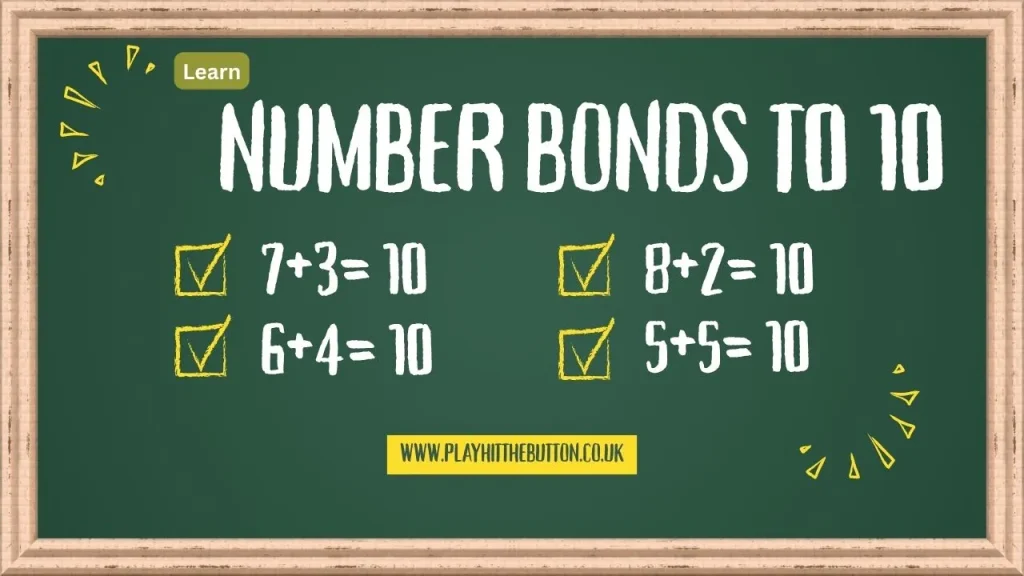
As the name suggests, when two numbers come together to make a bond, it is called a number bonds. In this case, if we say 6 + 4 = 10, it is the number bonds to 10 (both 6 and 4 are the number bonds). Two numbers that come together to make 10 are called number bonds to 10.
Here are the different number combinations that make number bonds to 10:
0 + 10 = 10
1 + 9 = 10
2 + 8 = 10
3 + 7 = 10
4 + 6 = 10
5 + 5 = 10
6 + 4 = 10
7 + 3 = 10
8 + 2 = 10
9 + 1 = 10
10 + 0 = 10
Each number can be flipped. If a child knows 8+2 makes 10, he also knows 2+8 makes 10.
Importance of Number Bonds to 10
In the early years, learning number bonds to 10 can help a lot for kids in their whole maths journey because kids can use these basic mental maths tricks in every aspect of their lives. Let’s find out how these number bonds can help children in different modes.
In School (KS1 & KS2)
As per the UK National Curriculum, kids must start learning number bonds to 10 from Year 1. Teachers use these number bonds every single day for both KS1 and KS2 students. They use them for column addition, subtraction and valuable lessons. If a student struggles to find two numbers that make 10, they will get confused when larger numbers are introduced in Year 3.
In Real Life
Numbers are everywhere around us. We use them daily. Yes, daily, and sometimes unintentionally. Your child will use these number bond combinations in the following conditions:
- To count their pocket money at the shop
- Check the scoreboard during a football match
- Calculate the time and see exactly how many minutes are left before bedtime at 10 o’clock.
Brain Automation
Research shows that the human brain has a limited amount of working memory. When your child automatically recalls number bonds to 10, they save massive mental energy. Their minds do not have to pause to count on fingers. Kids can use this empty brain space to focus on solving bigger arithmetic problems.
For example, when someone drives a car, once it becomes a habit, the brake and accelerator transform into automatic recalls.
4 Steps to Learn Number Bonds to 10
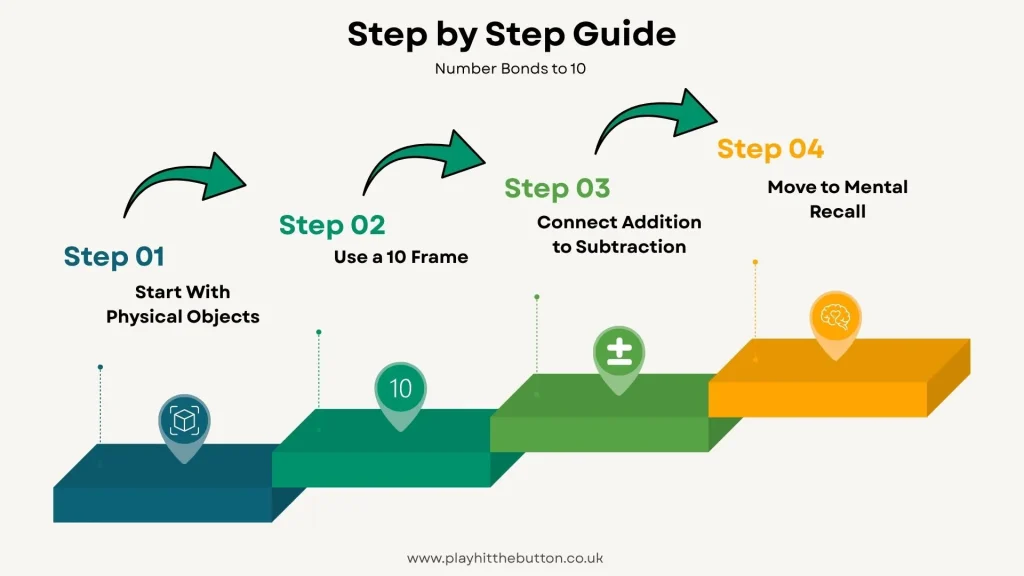
Teaching number bonds does not have to be a confusing guessing game for your child. Here are four simple steps to teach your child.
Step 1: Start With Physical Objects
Forget about pen and paper for a moment. Start with some physical things your child can actually touch. Grab 10 strawberries from the kitchen. Ask them to split the items into two separate hands. They will naturally see that 4 strawberries in one hand and 6 strawberries in the other hand still make 10 strawberries in total (4+6=10). Let them discover these matching pairs on their own instead of giving them the answers.
Step 2: Use a 10 Frame
A ten frame is a grid with two rows of five (2×5) empty boxes. You can manually draw this on paper in just less than 20 seconds. Place seven small counters inside the boxes and leave the rest empty. Your child will instantly look at the grid and see that seven filled spaces plus three empty spaces make ten. This simple visual trick builds a clear picture in their minds.
Step 3: Connect Addition to Subtraction
Once your child knows that 6 and 4make 10, you can easily show them the secret of subtraction here. Tell them you have 10 grapes and you eat 4 of them. Because they already know the addition, they will instantly tell you that 6 grapes are left. You are giving them 4 math facts within one single bond. This clever connection removes the fear of subtraction completely.
Step 4: Move to Mental Recall
Now, the basic concept is clear, and it’s time to build the speed. Throw away the boring worksheets and focus on rapid-fire verbal quizzes during the dinner or while driving. Shout out the number 4 and let them call back the number 6 without thinking in their mind. Keep these practice sessions short because three minutes of fast gaming beats a long study hour every time.
4 Easy Shortcuts to Learn Number Bonds to 10
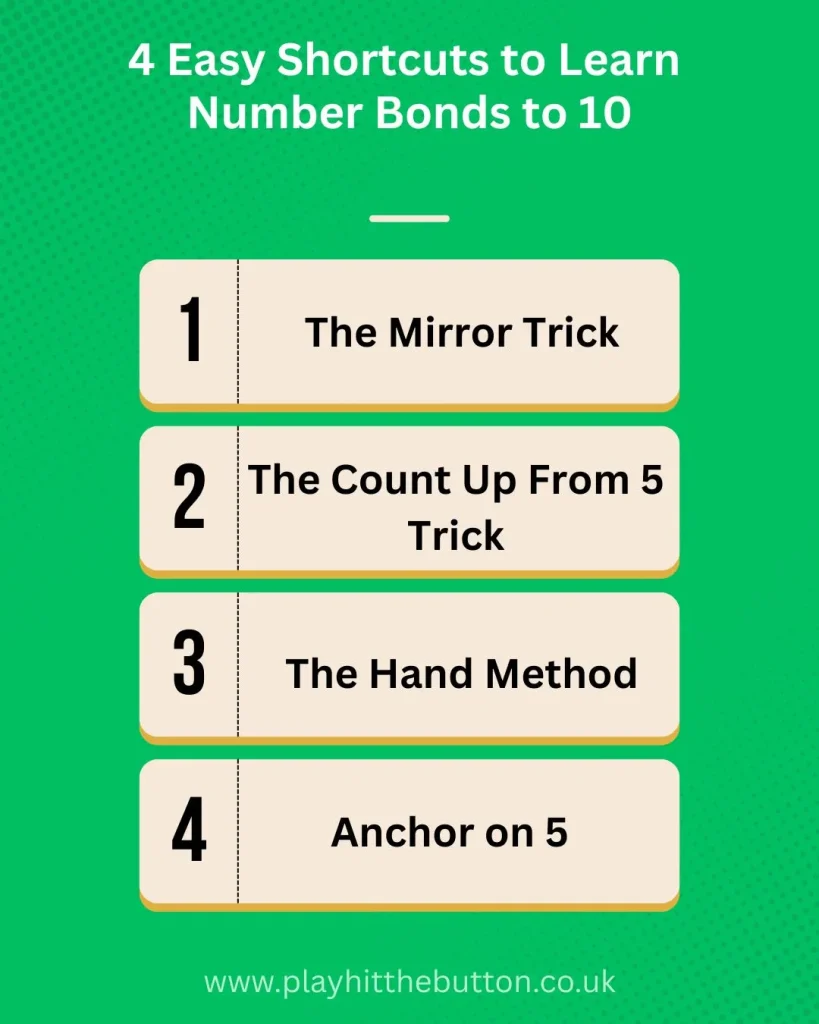
You can use the following mental shortcuts to make learning number bonds to 10 easier for your child.
1. The Mirror Trick
Show your child that numbers have a secret symmetry. If they already know that 4 plus 6 equals 10, they automatically know its flipped version. 6 plus 4 equals 10. Children get excited when they realise they already know the second half of the list without any extra work.
2. The Count Up From 5 Trick
You can use the number 5 as a stepping stone for any digit larger than 5. If your child sees the number 6, tell them it is just one digit larger than 5. That means they only need 4 more to reach 10. If they see the number 8, it is 3 more than 5, so they only need two more to make it 10.
3. The Hand Method
Your child has the ultimate calculation tool attached to their arms. They have 10 fingers in total. Ask them to hold up both hands and fold down three fingers. They can simply count the seven fingers to find the perfect match. This physical method is easy and always available whenever they feel stuck during school lessons.
4. Anchor on 5
The combination of 5+5 is the golden centre of all your practice. Every other number pair is just moving away from this middle point. If you add one to the first 5 to make 6, you must take one away from the second 5 to make 4.
6 Common Mistakes Children Make
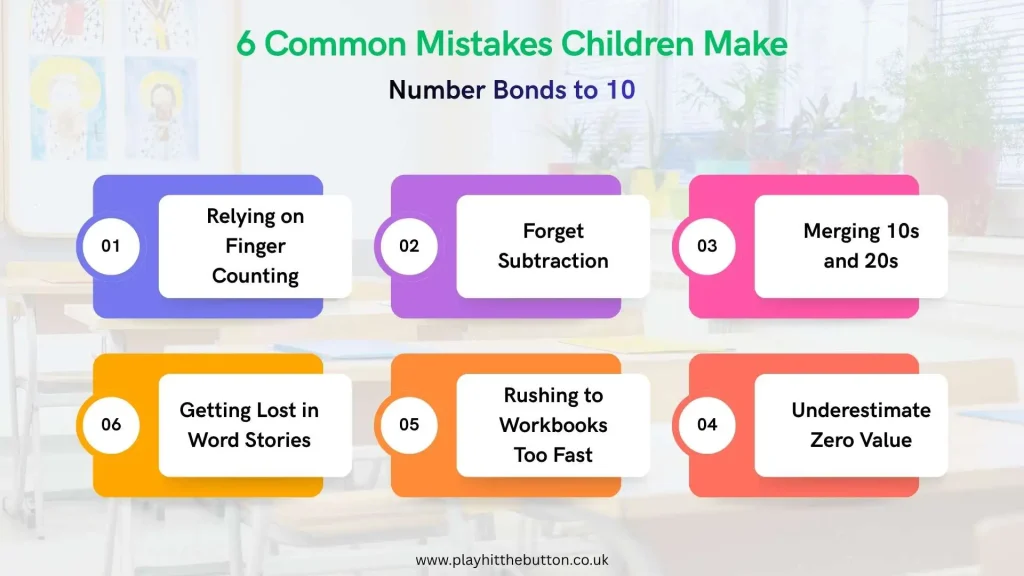
Kids get confused, and it’s normal. Here are the 6 biggest blunders they make and exactly how you can fix them at home.
1. Relying on Finger Counting
Many kids still count on their hands for every single question. They feel safe by counting their fingers because they don’t feel comfortable with mental maths.
How to fix: You must throw away the boring worksheets. Use fast flashcards or digital games to build instant memory instead.
2. Forget Subtraction
Children often think that adding and subtracting are completely separate worlds. They learn the addition side but get stuck on subtraction.
How to fix: Always teach the whole number family together. If they know 8 and 2 make 10, show them right away that 10 minus 2 makes 8.
3. Merging 10s and 20s
The numbers look very similar on paper as your child moves into Year 2. They mix up their targets and get frustrated. Try using bright colors to separate the ideas.
How to fix: Write all the pairs for 10 in bright blue ink and use bold red ink for the 20s.
4. Underestimate Zero Value
Kids often skip this pair because they feel like zero does not count as a real number. They just leave it.
How to fix: Explain to your child that zero has a very big value in maths. If we don’t put zero at the end of 1, it will not become 10!
5. Rushing to Workbooks Too Fast
School books often force kids to write down equations before their brains are ready. The concept is not solid yet.
How to fix: You must keep talking and playing with physical toys at home even after they start doing written schoolwork.
6. Getting Lost in Word Stories
A child might know the raw math but get completely stuck when words hide the problem. They do not see the math puzzle inside the sentence.
How to fix: Use real-life stories during playtime. Tell them there are 10 birds on a fence and 8 fly away, then ask how many are left.
3 Practise Methods of Number Bonds to 10
You do not need to force your child to sit at a desk for hours. Turn your daily routine into a quick game instead.
1. At Home
Being a parent, you can teach number bonds to 10 by using easily accessible household items. Use simple items you already have. For example, during bath time, you can split 10 plastic toys into two separate groups. At snack time, give your child 10 raisins and ask them to eat three. Ask them what number is missing to make the full 10. Kids will learn the concepts of number bonds to 10 very fast with these practical learning experiences.
2. In the Classroom
Teachers need active games that do not take hours to prepare. Try running a high-energy number relay race. Split the class into two teams and shout out a number. You can also feature a special “bond of the day” every single morning during attendance. This simple routine keeps number bonds to 10 fresh in their minds before the main lesson starts.
3. Real-Life Applications
Show your child that math has a real purpose. Give them exactly 10 pence when visiting a local corner shop. If a sticker costs 7 pence, let them figure out the exact change themselves. You can also use a simple scoreboard during family board games. Tell them that they need ten points to win. If they currently have 6 points, let them calculate how many more points they need to beat you.
Practise with Hit the Button Maths Game
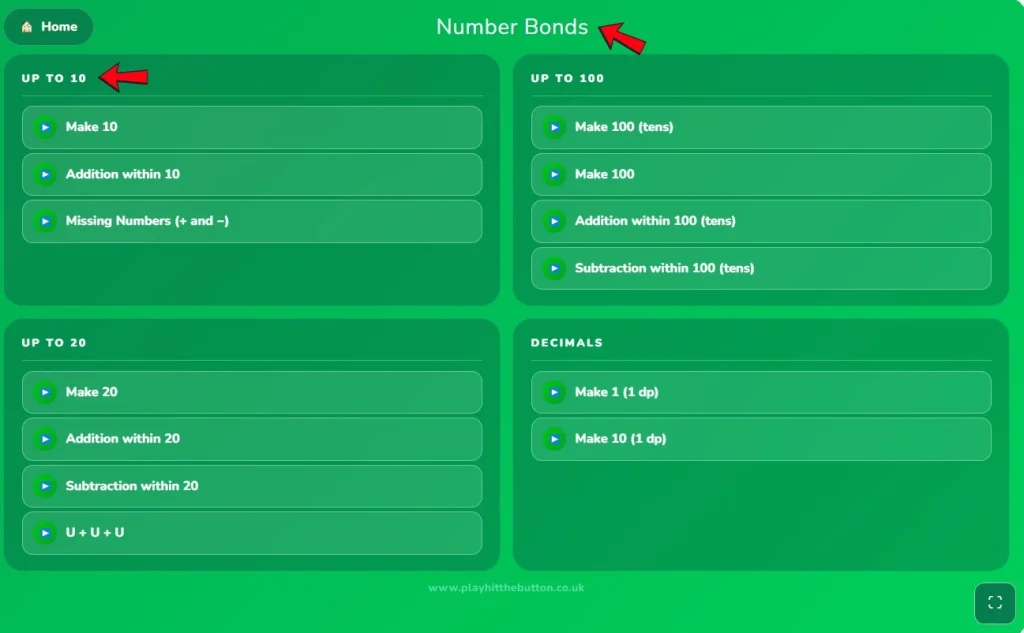
One of the best ways to build real speed in solving number bonds to 10 is by playing hit the button free online maths game, used daily in thousands of UK primary schools. You just need to select number bonds to 10 from the game menu and start practising number bonds to 10.
Here is why it works better than a worksheet:
“I use Hit the Button every morning as a two minute starter. The improvement in number bond recall across my Year 1 class over just four weeks was remarkable. Children who used to count on their fingers are now answering instantly.“
— Sarah Mitchell, Year 1 Teacher, Leeds
Hit the button online game also covers times tables, number bonds to 20, doubling, halving, and division facts. Once number bonds to 10 are solid, the next challenge is just one click away.
Number Bonds as Maths Foundation
When kids use their brain energy at a moment, that load on the brain is called cognitive load. Surprisingly, when kids start learning automatic recalls in number bonds to 10, they overcome the cognitive load. They can now use the free brain space to solve the harder maths problems.
For example, when a child has to solve 6+4, they will use less brain energy due to automatic recall. If they know the answer before thinking or counting on the fingers, it becomes easy to answer it. Once the kids have a strong grip on the number bonds to 10, they start applying this pattern everywhere. For example, when they see a percentage, they can relate it to 40%+60%=100%. This is where the actual practical learning takes off.
Practice Questions of Number Bonds to 10
Here are the practise questions of number bonds to 10 game.
Final Words
Learning number bonds to 10 leaves a strong impact on kids’ mental growth. Once a child knows them, they gain huge confidence and get stronger in their mental maths. After learning number bonds to 10, kids can learn number bonds to 20, times tables, and bigger arithmetic problems. The best next step is to play hit the button maths and try the number bonds to 10 mode right now.
If you want to understand the science behind why this kind of practice works for young learners, the Education Endowment Foundation has clear, research-backed guidance on what actually improves maths outcomes in primary education.